Against the background of rising electricity prices and frequent challenges to the stability of the power grid, more and more families have begun to think about a question: can we still use electricity stably without relying on the public power grid?
The answer is yes.
Off-Grid Solar System is becoming an important solution for families, remote cottages and RV users to achieve energy self-susficie. In the whole system, the off grid solar inverter is the "core brain" that determines whether the system is stable, safe and efficient.
This article will systematically take you to understand the working principle, selection logic and real application scenarios of off-gride inverters, so as to help you take fewer detours and truly build a reliable and sustainable independent power supply system.
I. Why do more and more people choose off-grid solar systems?
-
The power grid is not "reliable at any time"
In many areas, power outages are not incidental. Extreme weather, aging infrastructure, and power supply restrictions will make household electricity uncertain. For remote areas, cottages or wild residents, the power grid doesn't even exist at all.
-
The core advantages of the off-network system
- Completely independent power supply: does not rely on the public power grid
- Long-term saving of electricity bills: one-time investment, long-term income
- Green and low-carbon: renewable energy, reduce carbon emissions
- Highly flexible: suitable for a variety of scenarios such as families, cottages, RVs, etc.
To achieve all this, an off-grid solar inverter with stable performance is indispensable.
II. What is an off-grid solar inverter?
-
Off-network inverter vs network-inverter
To put it simply:
Type Grid-connected Can operate independently Grid-tie inverter Yes No Off-grid solar inverter No Yes The standalone solar inverter is specially designed for the scenario of "no grid" or "not dependent on the grid". Even if the power is completely cut off, the system can still supply power normally.
-
The core function of off-network inverter
- Convert direct current (DC) generated by solar panels into alternating current (AC)
- Work with the battery system to realize energy storage and release.
- Provide multiple security protection such as overload, short circuit, overheating, etc.
- Most integrated MPPT technologies improve power generation efficiency
It can be said that without an inverter, the off-grid solar system cannot really work.
III. What equipment does the off-grid solar system consist of?
A complete off-network system is not complicated, but each component is crucial.
| Component | Function | Key Specifications |
|---|---|---|
| Solar Panel | Generates electricity | Power (W), Efficiency |
| MPPT Controller | Maximizes energy harvest | Input voltage, Input current |
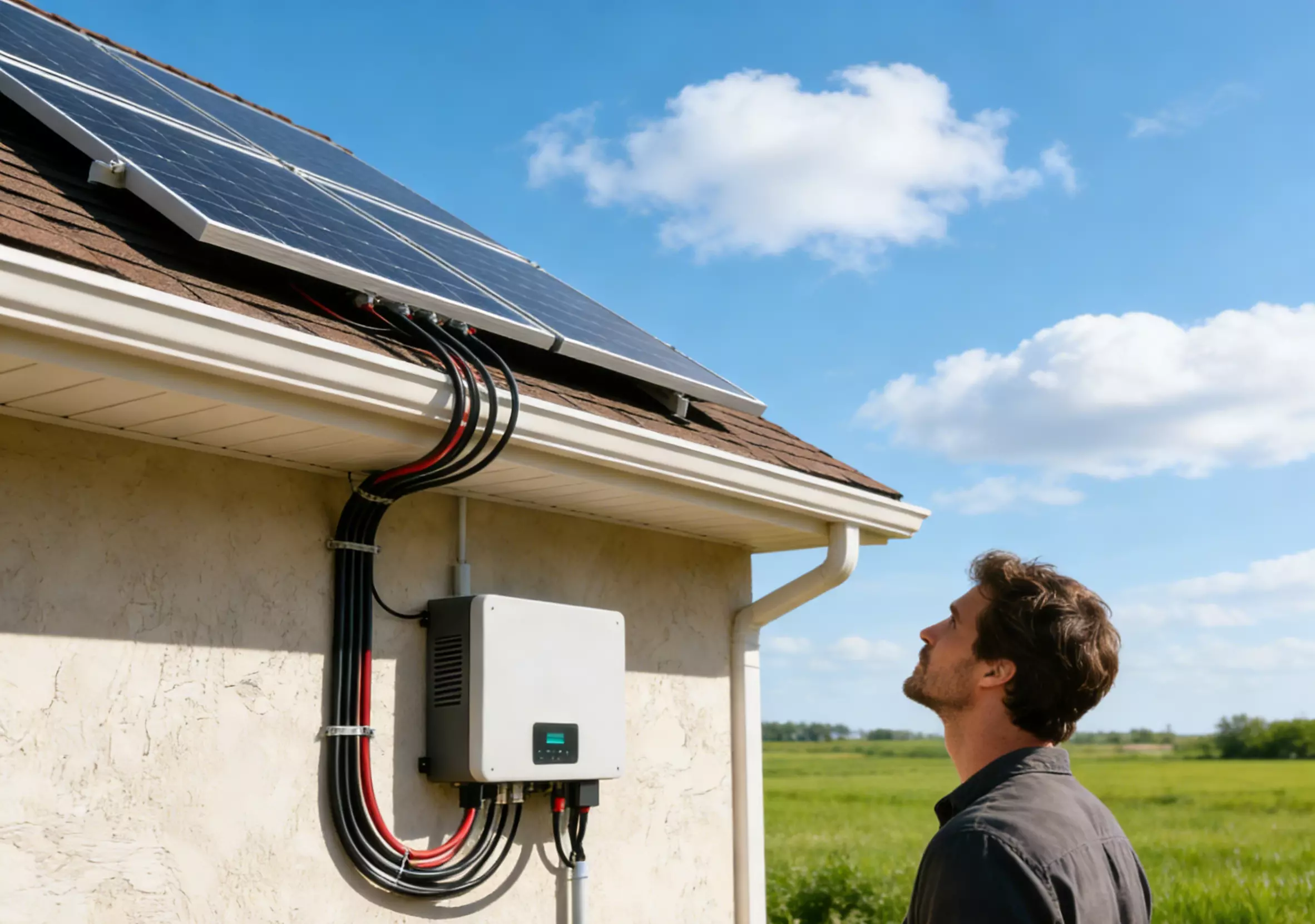
| Off-grid Inverter | Converts DC → AC | Rated power, Efficiency |
| Battery Bank | Stores energy | Capacity (kWh), Cycle life |
| Protection Devices | Ensures system safety | Circuit breakers, Surge protection |
Among them, off-grid inverter charger is becoming more and more popular because it integrates inverter, charging and control, and the system is more concise and reliable.
IV. Home off-network inverter: how to choose it without stepping on the pit?
-
How to evaluate the demand for household electricity?
First, list the main electrical equipment for home use:
- Refrigerator
- Air conditioner
- Illuminate
- Washing machine
- Network equipment
The key is not the "total power", but the peak load (the maximum power started at the same time).
-
How to choose the power of the inverter?
Basic formula:
Inverter rated power ≥ maximum load × 1.2–1.5 (safety factor)
For example:
Maximum load at home 4kW → It is recommended to choose a 5–6kW off-network inverter
-
Key parameters of family scenes
- Wide input voltage range (adaptable to different components)
- High conversion efficiency (≥95%)
- Support battery expansion
- Stable island mode PV inverter (island operation ability)
V. Cabin off-grid system: stability is more important than power
-
Characteristics of the use of the cottage
- The electricity load is not large.
- Most of them are unattended for a long time.
- High requirements for continuous power supply
-
Special requirements for inverters
- Low standby power consumption
- High reliability
- Waterproof and dustproof design
- Wide temperature working range (-20℃~60℃)
-
Typical configuration examples
- Medium-power solar panels
- MPPT controller
- Medium-capacity battery pack
- Stable independent solar power inverter
VI. RV off-network system: portable and intelligent are indispensable
-
Special features of the RV system
- Limited space and weight sensitivity
- Light conditions change rapidly.
- Move frequently
-
Key points of RV inverter selection
- High power density and lightweight design
- Support multiple inputs (solar energy / city power / generator)
- Low-noise operation
- UPS automatic switching function
-
Common RV off-line schemes
RV users usually choose the combination of solar inverter without grid + battery energy storage to achieve the true meaning of "as you go".
VII. How to further improve the power generation efficiency of the off-grid system?
-
Make MPPT more "smart"
- Multiple MPPT adapts to complex lighting
- Automatically handle the impact of shadow
- Real-time tracking of the maximum power point
-
Panel angle and orientation
- Fixed system: according to the annual average angle
- RV system: flexible direction adjustment
-
Battery status management
- Reasonable control of SOC / DOD
- Avoid extreme temperatures
- Optimize the charging and discharging strategy
VIII. Frequently Asked Questions and Misunderstandings (FAQ)
-
Q1: Do all inverters support off-grid?
No. You must choose an inverter that is clearly marked off-grid or island mode.
-
Q2: Does the off-network system have to be equipped with batteries?
Yes, without a battery, the system cannot be powered without light.
-
Q3: How long is the life of the off-grid inverter?
High-quality products can usually operate stably for more than 8–10 years.
-
Q4: Can it be combined with diesel generators?
Yes, many off-grid inverter chargers support generator input.
IX. Make the off-grid solar system really cost-effective and reliable
The off-grid solar system is not "a simple purchase of a few boards".
It is much more important to plan the system structure reasonably and choose the right inverter type than simply pursuing low prices.
Whether it is a family, a cottage or a RV scenario, a stable and efficient off grid solar inverter is the key to achieving long-term energy self-seneficiency.
If you are planning your own off-grid solar system, welcome to learn more about the inverter solution suitable for your scenario, so that solar energy can truly become a reliable and continuous source of electricity.