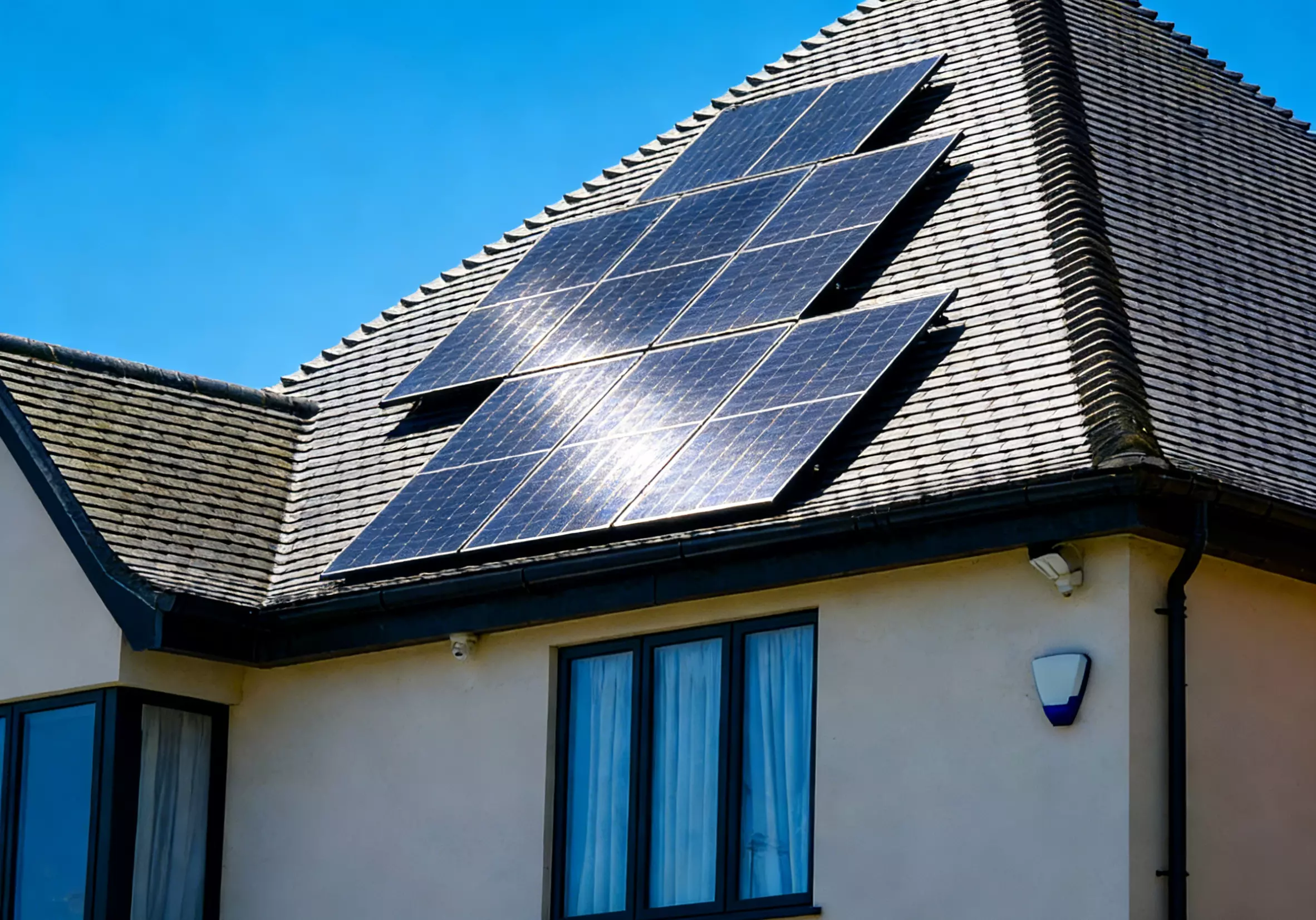
When solar power is generated from photovoltaic panels, the decision on how to transport it efficiently, stably and safely to the home power system or public power grid is not in photovoltaic modules, but in inverters.
When choosing a model, many users often only focus on the power of the component, but ignore a longer-term problem:
The choice of inverters will directly affect the efficiency and stability of the system, and whether it will be "locked" in the future.
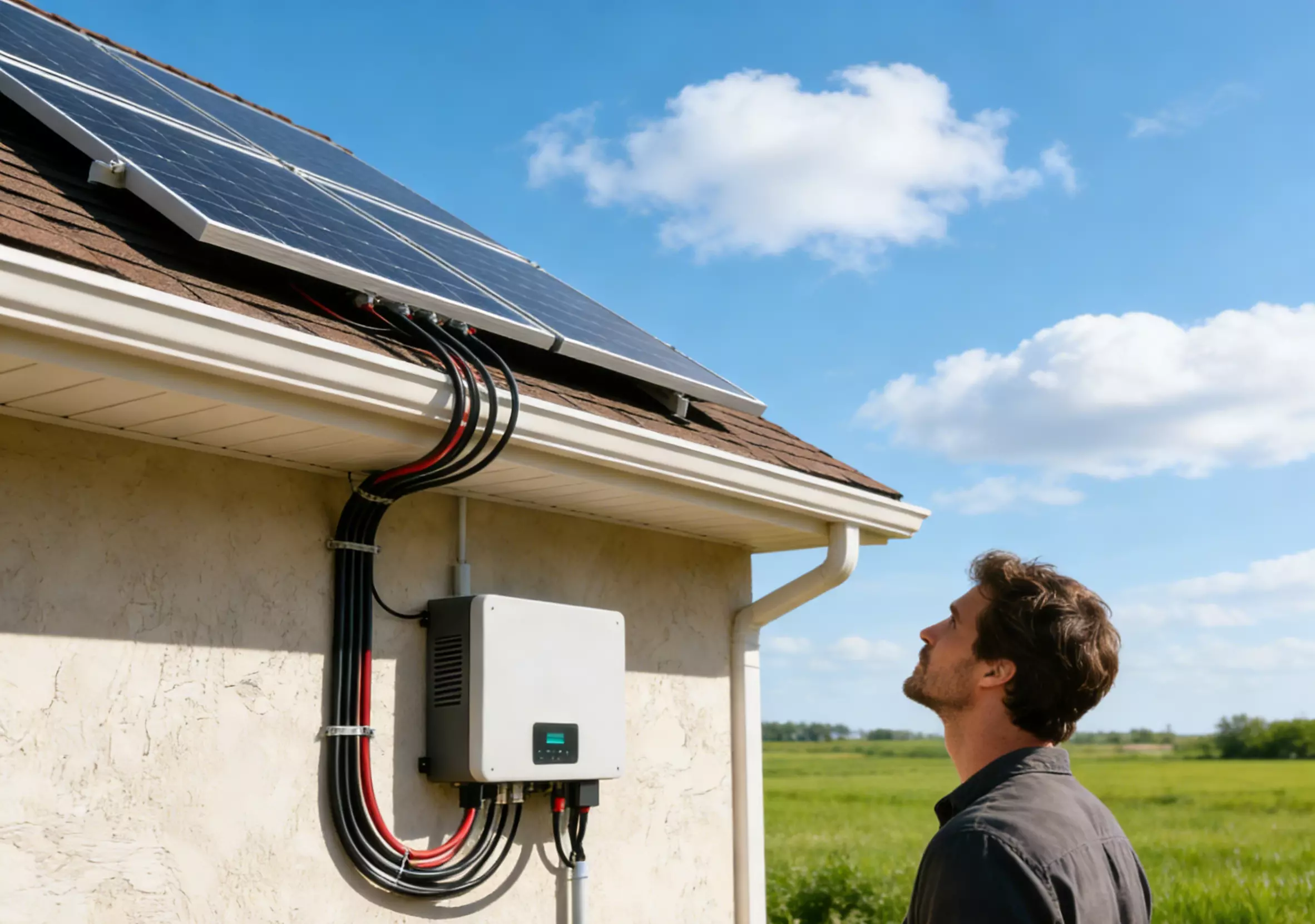
If you are considering using a string inverter, the question really worth asking is not whether it is good or not, but:
Is it suitable for your roof structure, electricity mode and future planning?
This article will focus on this core issue, systematically analyse the real performance, technical logic and selection points of group string inverters in home and commercial solar systems, and help you make choices that you will not regret.
I. What is a group string inverter? Understand its essence in the most concise way.
Among all types of solar inverters, string inverter is currently the most widely used scheme in the world, especially in residential and small and medium-sized commercial systems.
1. From the perspective of physical structure: what is "group string"?
The so-called "group string" is not a complex concept:
- Multiple photovoltaic modules are connected in series to form a "voltage string"
- Multiple series are connected in parallel to one inverter.
- The inverter uniformly completes DC→AC conversion and outputs AC power.
This structure allows the solar string inverter to achieve a balance between cost, efficiency and system complexity.
2. From the perspective of work logic: how MPPT affects power generation
String inverters usually adopt MPPT (Maximum Power Point Tracking) technology:
- Each MPPT controls one or more strings
- MPPT will optimise power based on the whole series of voltage and current.
Inconsistent performance of components in the string (occlusion, ageing) will affect the overall output.
This is also one of the fundamental differences between PV string inverter and micro inverter.
3. Core differences from other inverter types
| Feature | String Inverter | Micro Inverter | Central Inverter | Hybrid Inverter |
|---|---|---|---|---|
| Cost | Medium-low | High | Low per watt | Medium |
| MPPT Level | Per string | Per module | Multi-string central | Multi-string + battery |
| Fault Isolation | Moderate | Strong | Moderate | Moderate |
| Scalability | Medium | Strong | Weak | Strong |
| Typical Application | Residential / C&I | Complex roofs | Large power plants | Energy-storage systems |
Different structures determine the difference in the performance of the system in the face of shadows, capacity expansion and energy storage.
II. How does the core technology of string inverters really affect the power generation performance?
Compared with parameter stacking, users are more concerned about:
Will these technologies eventually make me generate more electricity or less electricity?
1. MPPT number of channels: the key to determining shadow tolerance
Single MPPT: Multiple strings share one control logic
Multiple MPPT: Strings of different directions or conditions can be optimised independently
In the actual roof, if there is a slight occlusion or orientation difference,
Multi-MPPT residential string inverters can significantly reduce power generation losses.
2. Voltage and current matching: Why "bad string" will reduce efficiency?
In the tandem structure:
- The current is subject to the weakest components.
- Voltage accumulation, but stability depends on consistency.
This means that if the component parameters are not matched properly, even if the inverter is very efficient,
The overall efficiency of the system may still be reduced by 5-10%.
3. Heat dissipation and reliability: the double-edged sword of centralised structure
Advantages:
- Unified heat dissipation design
- Maintenance point concentration
Challenge:
- Single-point failure affects the entire string group.
Pay attention to the protection level (IP65+) in a high-temperature environment.
III. The real performance of string inverters in the home solar system
1. Typical conditions for home roofs
Most home roofs have the following characteristics:
- The direction is relatively single.
- Less shadows (no cover or only slightly cover)
- System size 5–15 kW
Under these conditions, residential string inverter is often the most cost-effective solution.
2. Advantages in the home scenario
- The cost is significantly lower than that of micro-inverters
- Simple installation and clear wiring
- Mature technology and many brand choices
- High conversion efficiency and stable power generation
3. Potential disadvantages in the home scenario
- Local occlusion will affect the output of the whole string.
- Single-point faults have a large range of influence.
- The compatibility needs to be confirmed when adding the battery later.
For example:
If 1 component in a string drops by 30% due to shadow output,
The power generation of the whole series may decrease by 10–20%.
IV. Why are string inverters still the mainstream in commercial solar energy systems?
1. Typical characteristics of commercial systems
System capacity 20 kW – hundreds kW
Multi-string, multi-phase access
Sensitive to stability and TCO (Total Cost of Ownership)
Under these conditions, the advantages of commercial string inverter will be further amplified.
2. Energy scheduling and efficiency balance
Compared with a large number of miniature inverters:
- Group string to reduce the number of roof equipment
- Reduce the complexity of wiring
- It is more conducive to centralised monitoring and maintenance.
3. Long-term perspective of cost and maintenance
Although miniature inverters perform better under local occlusion, in large-scale systems:
The unit power cost and long-term maintenance cost of string inverters are more controllable.
V. Is your system suitable for group string inverters? Step-by-step judgement
Step 1: Roof conditions
- Obstruction is obvious / multi-slope → cautious
- Single orientation / less occlusion → suitable
Step 2: System scale
- <10 kW: group string or micro
- 10–50 kW: group string mainstream
- >50 kW: commercial group string / centre
Step 3: Do you plan energy storage or backup power supply?
- Yes → Prioritise hybrid inverter
- No → Stringing is more economical
Step 4: Budget vs Long-term Profit
| Option | Initial Cost | Generation Stability | Expansion Capability |
|---|---|---|---|
| String | Medium | High | Medium |
| Micro | High | Very High | High |
VI. Practical Guide to Selecting String Inverters (Don't choose the wrong parameters)
| Parameter | Meaning | System Impact |
|---|---|---|
| MPPT Channels | Number of independently controlled strings | Shade tolerance |
| Max. Input Voltage | Max. panels that can be wired in series | System design flexibility |
| Peak Efficiency | Conversion efficiency | Annual energy yield |
| Protection Rating | IP code | Outdoor reliability |
Don't just look at the "rated power",
The Matching Degree Between The Component Vmpp / Impp And The Inverter Is More Important.
VII. Common misunderstandings and FAQ
Misconception 1: Is the group string inverter inefficient?
→ On the uncovered roof, the efficiency is very high.
Misconception 2: Can't use it if there is a shadow?
→ Losses can be reduced through multiple MPPT and reasonable stringing.
Q: Can it be mixed with micro inverters?
→ It is feasible in special projects, but it needs to be designed professionally.
Q: Group string vs centre, which one is better?
→ The centre is suitable for super-large power stations, and residential and commercial buildings are mainly grouped.
VIII. Don't just look at the advantages and disadvantages, look at "whether it is suitable for your system"
Inverters are never "the more expensive the better",
It is whether it matches your roof conditions, electricity needs and future plans.
If you pursue cost-effectiveness and stable power generation → string inverter is a reliable choice.
If you plan to increase energy storage in the future → consider the hybrid plan in advance
If the system scale is large → commercial group string is still the mainstream
Before making a decision, evaluate the roof and then choose the inverter to truly maximise your return on solar investment.
Welcome to inquire for more information!