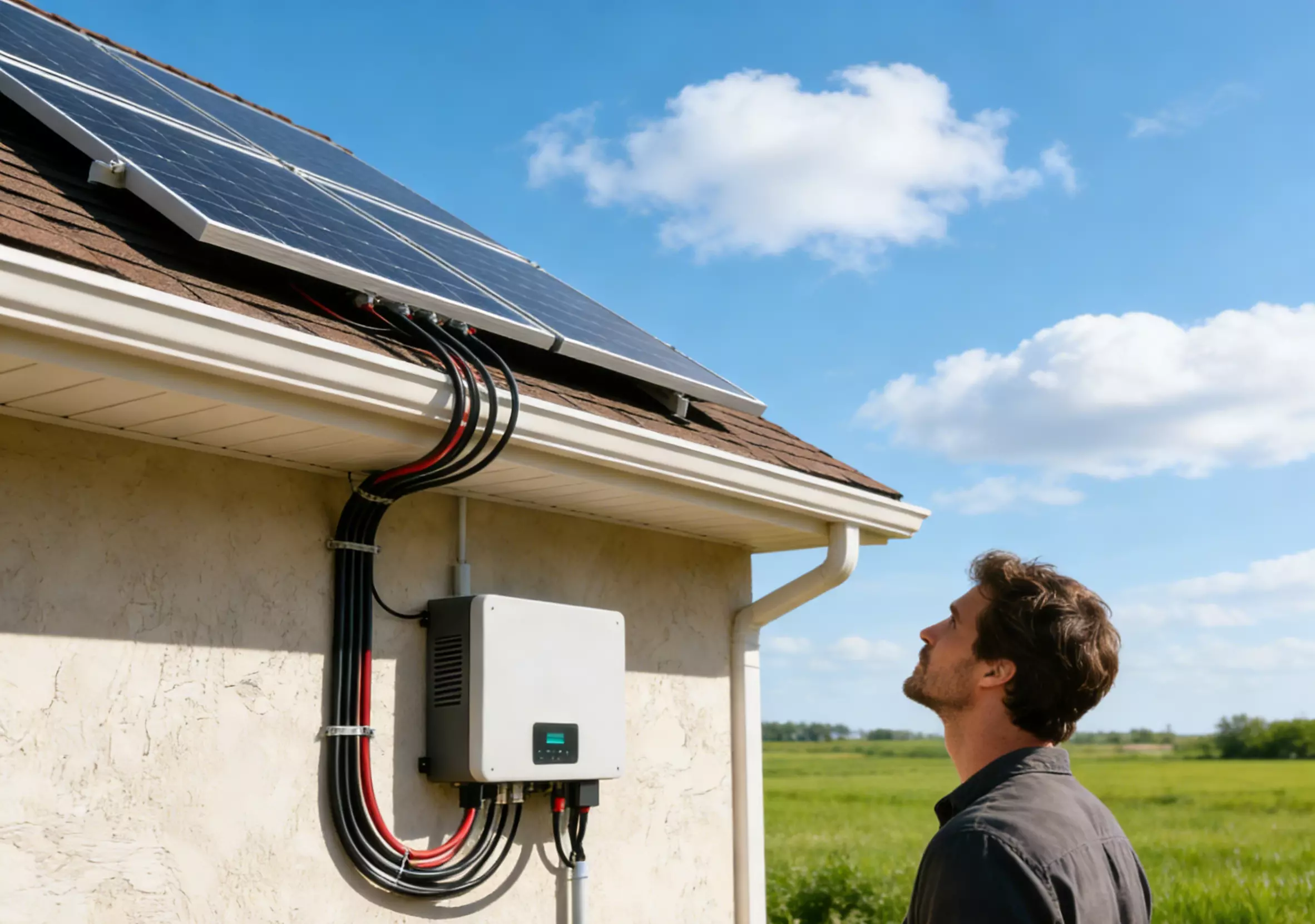
In the early solar energy system, the inverter only assumed the basic role of "direct current to alternating current"; and by 2026, with the popularisation of energy storage, electric vehicles and intelligent energy use, the inverter has evolved into the core control centre of the home energy system-- it determines how electricity is distributed, when it is stored, and whether it can continue to supply power in the event of a power outage.
If you are looking for a solar inverter with battery that is really suitable for home use, this article will help you make the right choice before installation, starting from the actual use scenario. Avoid being forced to replace the whole after a few years due to system restrictions.
I. Don't look at the list first: what kind of users do you belong to?
Before choosing any solar battery hybrid inverter, answer the following questions first.
| Question | Yes / No |
|---|---|
| Do you experience frequent power outages in your area? | |
| Are you planning to expand your battery capacity in the future? | |
| Do you want to reduce grid independence? | |
| Is there a significant price difference? |
According to the answer, most families can be divided into 4 categories:
- 1. Network-based, battery-based: Electricity usually comes from the power grid. The battery is mainly used for occasional power outages. PV inverter with battery that requires basic UPS function.
- 2. Frequent power outages, backup just need: Power outages have a great impact on life or work. The key load needs to be continuously charged. Requires a quick switching solar inverter backup unit.
- 3. Semi-deti-network / high self-safficiencity family: I hope to maximise my own use of solar energy. Use the electricity price difference to reduce the bill. Need an energy storage solar inverter equipped with EMS.
- 4. Completely off-line system: Farms, remote areas, cottages. Unable to rely on the public power grid. Requires an inverter battery system with strong off-line capability.
Different people have completely different answers to "the best inverter".
II. What is a "real battery-inverter"?
Many people think that: "As long as the battery can be connected, it is with a battery inverter." This is the most common and dangerous misunderstanding in 2026.
❌ Common misconceptions: Hybrid inverter = can definitely power outage; Can connect the battery = the battery can be fully utilised.
The reality is: Many inverters are directly cut off when the power goes out, and the battery is in the same shape as a virtual device.
✅ The correct standard for 2026: A qualified solar inverter with battery should have at least: Two-way energy flow control (charge/charge free), UPS or EPS mode (automatic power supply when there is a power outage), Battery priority is configurable, and EMS / Intelligent scheduling capability.
That's why starting from 2026: Inverter ≠ Electrical equipment, but the brain of household energy.
III. In 2026, why is the selection completely different from before?
It's not market speculation, but the underlying logic has really changed.
3.1 Battery price drop → Inverter determines the upper limit of the system
The battery is getting cheaper and cheaper, but if the inverter: High magnification discharge is not supported or Parallel expansion is not supported, the potential of the system will be "capped by hardware".
3.2 Electricity price fluctuations intensify → Time scheduling is more important than power generation
In 2026, how much electricity is no longer the only key. When to use and when to store electricity is the core. This puts forward higher requirements for the EMS capability of solar battery hybrid inverter.
3.3 EV and heat pump popularisation → Peak power is seriously underestimated
Many families underestimate: Charging electric vehicles and Air conditioning / heat pump start-up instantaneous power. The result is: The power of the inverter is not enough, and the power consumption experience collapses directly.
IV. The best inverter with battery in 2026: recommended by scenario
Don't do the "model ranking", only the "crowd solution".
Scene 1: Ordinary family + occasional power outage
Recommended characteristics: Power: 3–6 kW, 2 ways MPPT, Basic UPS functions.
Who is suitable for? ✔ Apartment / Ordinary Residence; ✔ Power outages are not frequent.
Not suitable for anyone: ❌ There are a lot of critical loads; ❌ Plan to quickly expand the battery capacity.
Scenario 2: Frequent power outages / critical loads are constantly charged
Core requirements: Switching time <10ms, Independent critical load interface, High instantaneous start-up power. In this kind of family, the switching speed of the solar inverter backup unit is more important than efficiency.
Scenario 3: High self-saficiety rate / electricity bill-optimised family
Key competence: EMS intelligent scheduling, Peak and Valley electricity price arbitrage, Deep utilisation of batteries. What really widens the gap is the software capability of energy storage solar inverter.
Scene 4: Off-net / Farm / Cottage
Must have: Completely off-line operation, Compatible with generators, Battery parallel expansion. In this scenario, stability > all parameters.
V. Don't be fooled by parameters: 6 key indicators that really affect the experience
- MPPT quantity ≠ actual efficiency: Multi-MPPT is only valuable when it is multi-oriented/shadowed.
- Rated power ≠ Peak capacity: When starting the air conditioner and heat pump, the peak power determines the success or failure.
- Whether the switching time is "insensitive": 20ms and 5ms, the experience is very different.
- Battery protocol compatibility: Incompatible = bound brand.
- Heat dissipation design and service life: Air-cooled/natural heat dissipation affects long-term reliability.
- Firmware and system upgradeability: After 2026, software is more important than hardware.
VI. A 5-minute selection formula
It is very suitable for being captured by Google as a selected summary.
- Step 1: Calculate the peak load (kW) - Air conditioner + refrigerator + kitchen + EV
- Step 2: Calculate the backup time (h)
- Step 3: Reverse inverter power - Peak load × 1.2–1.5
- Step 4: Confirm the battery type and protocol
- Step 5: Reserve 20–30% expansion margin
VII. FAQ
Q: Is it necessarily more expensive with battery inverter?
A: Slightly higher at the beginning, but the long-term return is better.
Q: Can I add batteries later?
A: The premise is that the inverter supports it.
Q: What electrical appliances can I bring when the power is out?
A: It depends on the peak power and load distribution of the inverter.
Q: Inverter life vs battery life?
A: Inverters are usually longer, but the upgrade ability is more critical.
VIII. The correct heart method of selecting inverters in 2026
Solar panels determine how much electricity you can send; Energy storage batteries determine how much electricity you can store; And the inverter determines whether your electricity is really used for the family. After 2026, the inverter will no longer be just an electrical component, but the "schedule centre" of the entire home energy system.
It not only affects today's power consumption experience, but also determines whether the system can continue to be upgraded and run stably in the next 5-10 years. If you don't want to be forced to replace the system as a whole in a few years, then when initially selecting the model, you should pay attention to whether a truly mature solar inverter with battery has:
- Native support energy storage system, compatible with mainstream battery types
- Intelligent energy scheduling ability, suitable for home load and electricity consumption habits
- Reserve an extended interface to support adding batteries, photovoltaics and charging piles in the future.
- Stable and reliable system architecture, suitable for long-term operation and upgrading
If you are planning a home photovoltaic or energy storage system, or if you still have doubts about the inverter selection, Welcome to contact our technical team to get system solutions that are more suitable for your home electricity scenario. Choosing the right inverter is not only easy to use at present, but also to prepare for home energy in the next ten years.