Energy Issues in Nigeria's Private Sector
Nigeria's grid is notorious for unreliability—with daily blackouts, zany voltage, and costly diesel. A number of businesses, mainly Lagos and Abuja supermarkets, are spending a lot of money on generators with fuel costs up 60% in recent years. Businesses lose revenue during outages, and customers become annoyed.
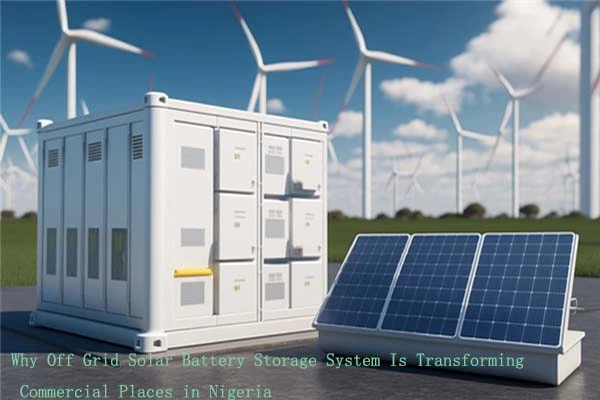
How Off-Grid Solar Battery Storage Delivers Value
An Off-grid Solar Battery Storage System integrates solar panels, lithium-ion energy storage batteries, PCS inverters, and EMS intelligence into one modular container. Specifications often look like this:
| Component | Specification |
|---|---|
| Energy Storage Container | 10ft container |
| Battery Capacity | 645 kWh high-density lithium-ion pack |
| Inverter / PCS | 300 kW bi-directional converter |
| Performance | 1C charge/discharge rate, AC-coupled architecture |
| EMS Control | Automatic switching, real-time monitoring |
This setup allows daytime solar generation to feed loads directly and store surplus energy for night or cloudy weather—providing uninterrupted power 24/7.
Real-World Case: Nigerian Supermarket Breakthrough
In Nigeria, a leading supermarket chain in the nation commissioned a 10-foot containerized BESS and combined it with a rooftop solar array to create an extremely autonomous power solution. The system is equipped with 645kWh of battery capacity and 300kW of photovoltaic PCS, and it achieves fully off-grid standalone operation.
Implementation Results
- Use rate of auto-generated power has increased to an impressive 95%, drastically reducing dependence on external energy.
- Elimination of diesel generators altogether reduces fuel costs, not to mention avoiding noise and exhaust fumes.
- The cost of running has been drastically reduced, and overall running costs have dropped more than 60%.
- Silent operation and zero pollution atmosphere enhance customer satisfaction and worker work environment.
- The system ensures the supply of electricity throughout the day, essentially bypassing running interruptions due to power failures, and increasing customer confidence and goodwill.
- In addition to extending business hours, it also pushes the development of operating income further.
Additional Proven Scenarios in Nigeria
Similar models have been adopted successfully across Nigeria:
- ATESS commissioned a hybrid solar mini-grid in Ogun State for over 10,000 users. A 1 MW PV field and 1.7 MWh battery system provided round-the-clock power to residential, school, and commercial loads.
- Academic modelling of the load of a Port Harcourt supermarket (~59.8 kW/day) found that a solar + battery + backup solution vastly outperformed power from a sole generator, both in terms of cost and emissions savings.
Benefits at a Glance
- Reliable Power: Eliminates outages and disruptions during business hours.
- Lower Lifetime Cost: Return on investment usually within 2–4 years when grid and generator expenses are included.
- Environmentally Friendly: Zero-emission operation, satisfying sustainability goals.
- Energy Autonomy: Less reliance on national grid; incremental capacity additions possible.
- Ease of Deployment: Modular containers quickly installed, minimal on-site civil work.
Why Choose Huijue Group's Off-Grid Solutions
Huijue Group offers industrial-grade Containerized BESS and energy storage cabinets, featuring:
- High-safety Lithium Iron Phosphate (LFP) batteries
- Integrated BMS/EMS for intelligent control and protection
- Modularity for ease of deployment and expansion
- Excellent after-sales service including remote diagnostics and maintenance support
You can explore our product line here.
Final Thoughts
An Off-grid Solar Battery Storage System is more than just a backup power solution—it’s a strategic investment in business continuity, cost savings, and environmental stewardship. Real-world success in Nigeria's supermarkets and communities proves its effectiveness. When powered by reliable hardware and proactive support like Huijue’s, this technology is ready to power the future of African commerce and beyond.