
In the perception of many home users, as long as solar panels are installed, the system will "automatically generate electricity efficiently". But this is often not the case in reality.
A large number of rooftop solar systems are unknowingly wasting 10%-30% of their power generation.
What really determines whether the system can transform "sunlight" into the core of "usable power" is not only the component itself, but also whether the inverter is equipped with MPPT (Maximum Power Point Tracking) technology.
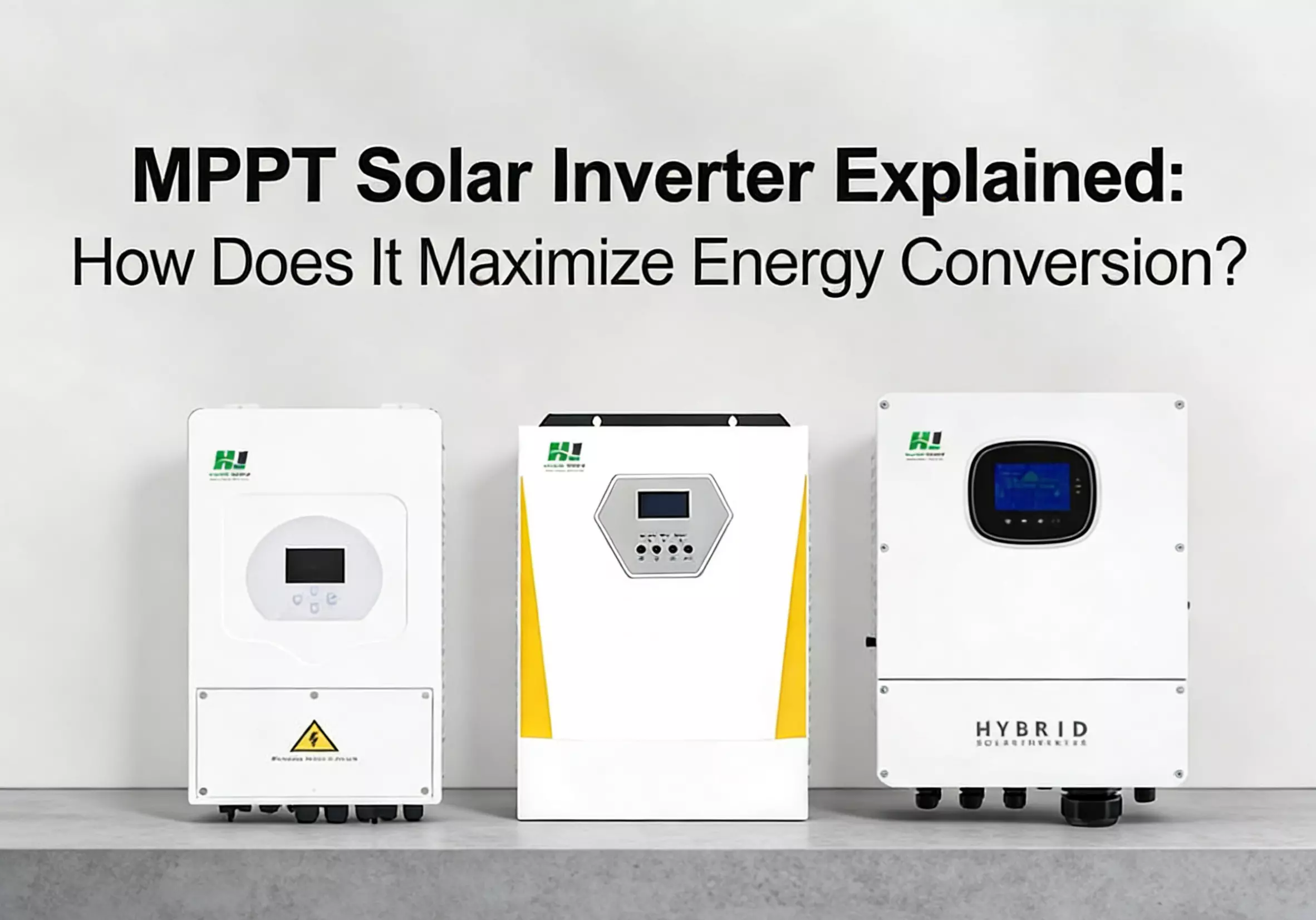
This article will systematically explain:
- What is MPPT solar inverter?
- How does MPPT improve power generation efficiency in the real environment?
- The essential difference between MPPT and traditional inverters
- Which parameters are the most critical when selecting models for home users?
Ⅰ.Why is the efficiency of the solar system more easily wasted than you think?
Solar panels are not always working in the "best state"
Many people think that as long as the sunlight shines on the solar panels, the maximum power can be output stably. But in fact, the output power of solar panels changes dynamically.
Influential factors include:
- Changes in the strength of light (sunny, cloudy, morning and evening)
- Changes in ambient temperature (high temperature will lower the voltage)
- Local shadow (tree shadow, antenna, chimney)
- Differences in component performance caused by dust and aging
In these cases, the voltage and current combination of the component will constantly change.
Without intelligent tracking, the system may lose a lot of power in vain.
If the inverter only "passively accepts" the component input and does not actively look for the best working point, then:
- Actual output power ≠ The maximum power that the component can output
In the long run, the annual power generation gap is very clear.
This is the core value of MPPT technology.
Ⅱ.What is MPPT? It is not a component, but a set of "intelligent tracking logic"
The full name and core role of MPPT
MPPT stands for Maximum Power Point Tracking, which refers to the technology that optimizes the power output of a solar system by tracking the maximum power point.
The simple understanding is:
- Let the solar system try to work in the "most cost-effective power generation state" in any environment.
The so-called "maximum power point" refers to the position where the output power reaches its peak at a certain moment under the combination of solar panel voltage and current.
MPPT is not a hardware, but an intelligent algorithm in the inverter.
Many users mistakenly think that MPPT is an independent component. In fact, it is a set of control logic embedded in the inverter.
An MPPT solar inverter will continuously perform the following processes:
- Collect voltage and current data of solar panels
- Calculate the current power in real time
- Judge whether there is a better working point
- Dynamically adjust the input parameters to make the system approach the maximum power point.
This is a continuous intelligent control process, not a one-time setting.
Ⅲ.How does MPPT work? From "static principle" to "dynamic tracking"
What are the I-V curves and P-V curves of solar panels?
No need for formulas, just remember one key fact:
- Each solar panel has different "best output points" under different light and temperature.
This point is not fixed, but constantly moving.
Therefore, yesterday's optimal voltage does not apply to today; the parameters in the morning do not apply to the afternoon either.
Dynamic tracking process of MPPT
MPPT can be imagined as a process of continuous "testing and correction":
- Monitoring: Read the current voltage, current and power
- Judgement: Compare the power changes before and after the adjustment
- Adjustment: Fine-tune the parameters in the direction of higher power
- Re-monitoring: form closed-loop control
This process will be repeated several times per second.
Brief description of common MPPT algorithms
- Disturbance observation method (P&O): simple logic and wide application
- Incremental Conductivity Method (INC): Faster response, suitable for scenes with frequent light changes
The specific algorithm implementation is completed by the inverter manufacturer. Users do not need to go deep, but it can be used as a reference to judge the professionalism of the equipment.
Ⅳ.How much efficiency can MPPT really improve? Real scenes are more important.
Ideal conditions vs real roof environment
Under laboratory conditions, the difference between ordinary systems and MPPT systems is not always obvious.
But in the real environment:
- Light changes
- Shadow cover
- Temperature difference fluctuation
These are all "non-ideal working conditions", and it is precisely where MPPT is best at playing a role.
In the following scenarios, MPPT is almost "just needed"
- Areas with frequent cloudy and rainy weather
- There is a morning and evening shadow on the roof.
- Areas with a large temperature difference between winter and summer
- Off-grid or hybrid solar system
Under these conditions, the power generation gain brought by MPPT tends to be closer to 20%-30%.
Ⅴ.The core difference between MPPT and PWM inverters
The essential differences in control methods
- PWM: Passive matching, the component voltage is "pulled" to the battery or system voltage
- MPPT: Active optimization, always find the best power point
The upper limit of power generation efficiency is different.
- There is a clear ceiling on the efficiency of PWM.
- The efficiency of MPPT is dynamically improved with environmental changes.
Why does the new system almost no longer recommend PWM?
- The price of components is falling, and efficiency is more important.
- The popularization of battery systems has higher requirements for charging efficiency.
- Energy storage and intelligent energy management have become trends.
Ⅵ.Which solar systems are MPPT inverters suitable for?
- Grid connection system: MPPT grid inverter to improve roof utilization rate
- Off-network system: MPPT charge inverter to improve battery charging efficiency
- Hybrid system: MPPT hybrid inverter, both power generation and energy storage
- Battery system: reduce energy loss and improve the overall self-satisfience rate
Energy storage system + MPPT = higher overall system efficiency
Ⅶ.What key parameters do you need to pay attention to when choosing an MPPT solar inverter?
This is the most likely step for many home users to make a mistake.
- MPPT number of routes
- Single MPPT: Simple roof conditions
- Double MPPT: different orientations or local occlusion
- Input voltage range
- Whether to cover the series voltage of the component
- Whether to reserve space for expansion
- Track the response speed
- When the light changes, the faster the response, the lower the loss.
- Compatibility with battery / EMS
- Whether to support energy storage access
- Whether to support the future upgrade of the energy management system
- Remote monitoring and intelligent interface
- Real-time monitoring
- Operation and maintenance are more convenient.
If you are comparing different models of MPPT solar inverters, you can click here to view a more complete product catalog and technical specifications.
Ⅶ.Common misunderstandings about MPPT solar inverters
- Is MPPT suitable for small systems?
Yes, the 3–5kW home system also benefits significantly.
- Will MPPT increase the complexity of the system?
It is almost insensitive to users, and the complexity is digested by the inverter.
- Must MPPT be more expensive than PWM?
The initial cost is slightly higher, but the long-term return is better.
- How many MPPTs does a system need?
It depends on the roof structure, not the more the better.
Ⅷ.Why has MPPT become the "efficiency core" of modern solar systems?
MPPT is not a marketing gimmick, but:
- The necessary technology to deal with unstable solar resources
- Key factors to improve the long-term income of the system
- The "standard capability" of modern high-efficiency solar systems
If you want to build a truly efficient, scalable and suitable system for future energy storage upgrades, it is more important to choose a suitable MPPT solar inverter than simply pursuing component power.