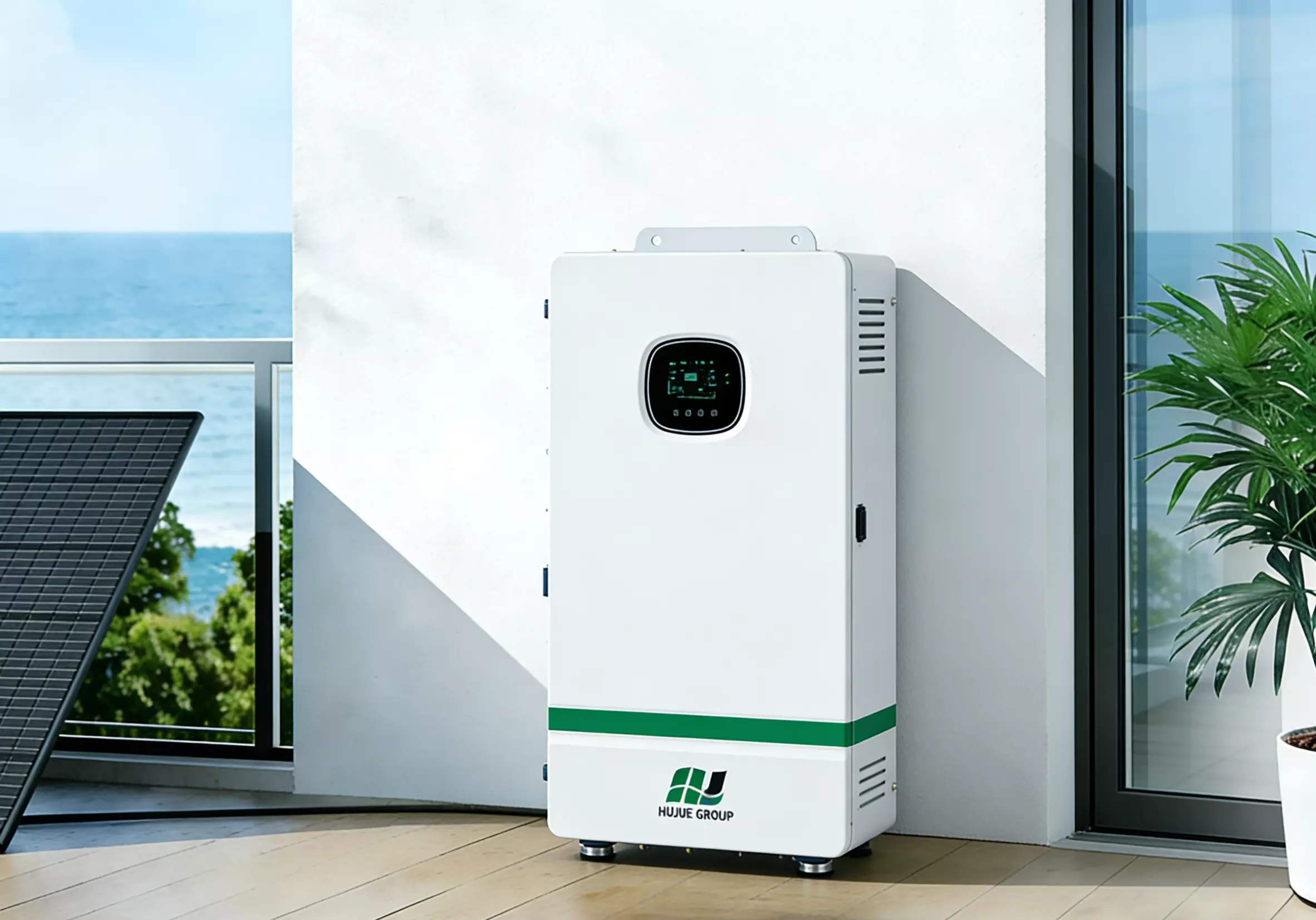
If I have been connected to the power grid, do I still need to store energy? What exactly can the grid-connected solar inverter bring me? I believe this is a question for many families and business users.
In all grid-connected photovoltaic systems, on grid solar inverter is one of the most critical core equipment. It is not only responsible for converting solar energy into usable electricity, but also undertakes the task of "dialogue" with the public power grid, which directly determines the safety, stability and economic benefits of the system.
This article will take you to a comprehensive understanding in a popular and systematic way:
- What is a grid-connected solar inverter?
- How does it work?
- The essential difference from off-network and hybrid inverters
- In which scenarios is it most suitable to choose a network-line inverter?
- How to choose the right model for home or industrial and commercial systems?

I. Why is the grid-connected inverter the core of the home/industrial and commercial photovoltaic system?
In most countries and regions, the power grid is still the most stable and reliable energy infrastructure. Based on this reality, Grid-Tied PV System has become the current mainstream form of solar energy application.
In the network-attaching system:
Solar panels are responsible for power generation.
The power grid as a backup power supply with "unlimited capacity"
Grid-connected solar inverters are the "bridge" between the two.
It not only completes the electrical energy conversion from DC to AC, but also needs to ensure that the output electricity is completely consistent with the power grid in terms of voltage, frequency and phase, so as to be safely connected to the grid.
In a word, without a grid-connected inverter, the electricity from photovoltaics cannot be safely and efficiently connected to the power grid.
II. What is a grid-connected solar inverter?
2.1 Basic definition of network-line inverter
On grid solar inverter is a kind of power conversion equipment specially used for grid-connected photovoltaic systems. Its main functions include:
Convert direct current (DC) generated by photovoltaic modules into alternating current (AC)
Real-time synchronization with the public power grid
Feedback the excess electricity to the power grid
Automatically disconnect when the power grid is abnormal (anti-island protection)
2.2 The core differences between networked, off-networked and hybrid inverters
Many users are easy to confuse these three types of inverters. The essential differences are as follows:
| Type | Grid-dependence | Battery required | Export to grid |
|---|---|---|---|
| Grid-tie inverter | Required | No | Yes |
| Off-grid inverter | Not required | Yes | No |
| Hybrid inverter | Optional | Usually yes | Usually yes |
Key points:
Grid-onned inverters cannot supply power alone during power outages, which is the biggest difference between them and hybrid and off-grid systems.
III. How does the grid-connected solar inverter work?
This is a key part of understanding the value of the network-online system.
3.1 DC → AC conversion: basic but indispensable
The output of solar panels is direct current (DC)
Households and power grids use alternating current (AC)
The Grid-Connected Inverter Is Responsible For Completing High-Efficiency And Low-Loss Electricity Conversion.
3.2 Maximum Power Point Tracking (MPPT)
Almost all modern network-lined inverters integrate MPPT (Maximum Power Point Tracking) technology:
Real-time monitoring of photovoltaic panel voltage and current
Dynamically find the best output power point
Maximize the power generation when the light changes and the temperature fluctuates
This is also one of the core sources of the difference in the efficiency of network-lined inverters.
3.3 Synchronization and protection mechanism with the power grid
Grid-line inverters must do:
Frequency synchronization (such as 50Hz / 60Hz)
Voltage synchronization
Phase matching
At The Same Time, It Has Anti-Islanding Protection:
Once a power outage is detected in the power grid, the inverter will stop output immediately to avoid risking maintenance personnel and equipment.
3.4 The flow of electricity after being connected to the network
The energy distribution in the networked system usually follows:
Priority supply of local load (spontaneous use)
The excess power is fed back to the power grid
When the battery is insufficient, replenish it from the power grid.
This is also an important source of the economy of the network system.
IV. Core advantages of grid-connected solar inverters
Why do so many families and enterprises choose network-lined systems? The reasons are mainly concentrated in the following points:
4.1 Maximize the use of solar energy resources
The excess power is not wasted, and it can be directly merged into the power grid.
4.2 Significantly reduce electricity expenditure
Reduce the purchase of electricity during the day
In some areas, you can get electricity compensation or deduction.
4.3 The system structure is simpler
It can run without batteries.
The number of equipment is less.
The initial investment is lower
4.4 The output is more stable
The power grid itself participates in the adjustment, and the system runs more smoothly.
V. When should you choose a network-line inverter?
5.1 Typical applicable scenarios
✔ Home roof photovoltaics
The power grid is stable
I hope to reduce the electricity bill.
✔ Industrial and commercial roofing system
Large load
The peak of electricity consumption during the day is obvious.
✔ Electricity price time-staling (TOU) area
During the day, photovoltaics cover high-priced electricity consumption periods
5.2 Not suitable for network-line inverters
No power grid coverage area
Zero tolerance for power outages (hospitals, data centers)
Completely independent energy demand
5.3 Grid-to-line + energy storage vs hybrid inverter
If you want to add batteries in the future:
Grid-line inverter + independent energy storage: low cost, but complex system
On-grid hybrid inverter: slightly expensive in the early stage, but more flexible
VI. How to choose a suitable grid-connected solar inverter?
6.1 Preliminary matching according to the scale
| Scenario | Recommended Power | Configuration Tips |
|---|---|---|
| Small household | 3 – 5 kW | Single MPPT, high efficiency |
| Large residential | 5 – 10 kW | Multiple MPPTs |
| Commercial & industrial | > 10 kW | Multiple MPPTs + full grid-code certifications |
6.2 Key points of key technical parameters
MPPT Road Number: Affecting the Power Generation Efficiency of Complex Roofs
Conversion efficiency: Peak / CEC efficiency
Protection level: IP65 or above is more suitable for outdoor
Grid certification: UL / CE / IEC, etc.
6.3 Installation and after-sales service cannot be ignored
Whether to support remote monitoring
Whether there is built-in anti-island protection
Whether it is compatible with the future energy storage system
VII. Frequently Asked Questions about Network-on System (FAQ)
✔ Can the inverter still work when the power is out?
Can't. For safety reasons, the power grid will automatically shut down after the power is cut off.
✔ Can the battery be added to the network-connected inverter?
Traditional Grid-Inverters Are Not Good. Hybrid Inverters Or External Energy Storage Systems Are Needed.
✔ Does the network-line inverter need to be maintained?
Maintenance requirements are low, and it is enough to check the wiring and heat dissipation regularly.
✔ What should I do if the synchronization with the power grid fails?
It is usually related to parameter setting, power grid quality or certification, and should be checked by professionals.
VIII. Grid-connected inverter is the "bridge" of modern photovoltaic systems.
Under the current reality of high coverage of the power grid, grid-connected solar inverters are still one of the most cost-effective photovoltaic core equipment.
It connects solar energy and the power grid, which determines the system:
Power generation efficiency
Security level
Long-term economic returns
Choosing a grid-connected inverter is not only about choosing equipment, but also laying the foundation for the whole photovoltaic system.
If you are planning a home or industrial and commercial photovoltaic system, welcome to consult. We will scientifically customize the grid-connected inverter scheme for you according to your own electricity structure, power grid conditions and future expansion needs, so as to maximize your solar energy investment value.